
The Jade Clock
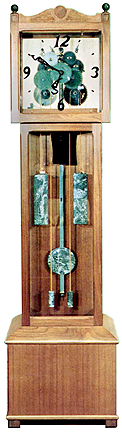
There are plenty of "jade clocks" to be found (just do a simple search on Google), virtually all of them made the conventional way - quartz or mechanical movements made with metallic parts - housed in or decorated with jade. To our knowledge, however, there is no other truly jade clock in existence than the masterpiece conceived and created by members of the San Francisco Gem & Mineral Society more than 50 years ago.
It is fitting to reminisce about this exceptional legacy as "Jade," is a stone that continues to hold a high level of fascination for a large number of club members, for its incredible toughness, durability, mystique and natural beauty.
Our jade clock is a full sized grandfather clock with a 16-jewel jade movement and jade strike train. Every piece of the clock was carefully designed, mocked-up in wood and tested for fit before being cut, carved and polished in the actual jade. The clock's 16 jewels were crafted from Chatham emeralds. The clock is housed in a case made of American black walnut and clear Plexiglas to allow complete visibility of the movement and strike train, and topped with spherical jade finials. Countless thousands of hours and hundreds of pounds of valuable jade, much of it from rare California localities, were donated to the project in an unprecedented team effort over a five year period of time.
The clock was first displayed at the California Federation of Mineralogical Societies' show held in San Mateo in 1959, sans strike train which was subsequently completed in time for the SFGMS show of 1962. The entire project was documented in a series of articles by club members Helen Stiles Chenoweth and Ted Bhend in the Lapidary Journal, which were then woven into a 12-page brochure appropriately titled "The Jade Clock." It fully documents the entire process and credits the dedicated club members behind this remarkable achievement. A PDF file of the brochure can be downloaded by clicking here. (This is a 3.3 MB file, it may take a few moments to display).
Postscript:
Not too long after posting the above information about the Jade Clock we received an email from Mary Jacoby, the Great Granddaughter of one of the principal designer/builders of the clock, Henry Reinecke. Mary spoke of Henry's great stories and his well earned pride in the Jade Clock. She still has, and generously offered to send us a copy of a wonderful article by Judy Vaughn from the San Francisco Sunday Chronicle, Bonanza Section, dated October 11, 1964. You can download a PDF file of this article by clicking here. (This is a 3.5 MB file, it may take a few moments to display). We are grateful to Mary for her contribution and share her fond memory of her Great Grandfather!
The Jade Train
It has been suggested that to mention the San Francisco Gem & Mineral Society in certain circles is to evoke images of jade, and it is understandable why this might be. Backtracking through the club's history reveals a definite pattern of enthusiasm for "the stone par excellence" demonstrated through an impressive number of club projects. We are by no means limited to jade on our projects, it has just worked out this way - which says a lot about the mystique jade has generated for thousands of years from ancient China to Mezzo-America, British Columbia to New Zealand.
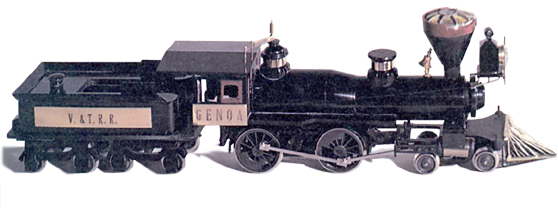
In the 1970's, the allure of jade prompted club members to collaborate in the creation of a 1/4 scale (1/4 inch = 1 foot) electric train made entirely (well, almost) of jade. It was completed in time to be featured at the California Federation of Minerolagical Societies' "Spirit of '76" annual show at San Francisco's Cow Palace on the Bicentennial weekend of July the 4th, 1976, and hosted by the SFGMS.
The train, which includes the engine, a tender (coal car), a passenger coach and a combination passenger coach and baggage car, is constructed of hundreds of precision crafted parts of Wyoming black jade, Porterville jade, Mariposa jade, Clear Creek jade, Burmese jadeite, British Columbia jade, red jasper, petrified wood and quartz from Brazil and Uraguay. All the materials were donated by the generous members and friends of the SFGMS, along with the thousands of man hours required to work and assemble the components. The train, trimmed with gold-plated engraved silver signage, a silver cow-catcher and numerous cast silver parts ran on a 4 foot by 8 foot oval track at the Spirit of '76 show.
A partial list of participants in the project include:
-
George Cross - light and boiler front
-
Jack Zari - journal boxes for trucks, sand & steam domes, brake shoes
-
Al Clayhold - smoke stack & bolster
-
Dick Dierx - drive rods, project co-chairman
-
Evan Robinson - running boards
-
Henry Reincke - all coring and drilling
-
Andre Pancheco - cab & boiler
-
Mike Schisler - gold plating and casting
-
Paul Jacobson - casting
-
Frank Gemmell - cars and some trucks
-
Franz Roth - coal car
-
Al Sims - name plates
-
Charles Hoffman - seats and fire box cover
-
Lee Guth - flat lappinf and owrk on cars
-
Walter Koniuk - steps for the coal car and water tower
-
Jim Morton - project draftsman
-
Les La Berge - project co-chairman
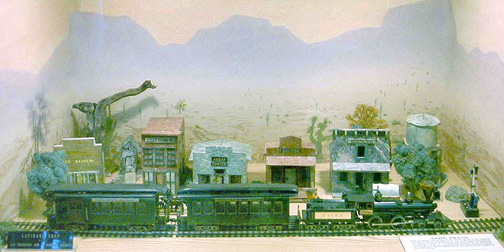
Jade train, with tender, coach and baggage car sits on track in front
of the town made up of jade buildings.
Completion of the train spurred yet another jade "project" in the crafting of a western style railhead town, also constructed primarily of jade. We'll add details about the "jade town" sometime soon. An article titled "The Jade Train" by former club president Faith E. Riesen documenting the train with much greater detail is available (532 KB downloadable PDF file - click the link) from the June 1976 issue of "Jewelry Making, Gems and Minerals" magazine. The train and town were displayed at the SFGMS's 55th Annual Show and Sale in Golden Gate Park, August 1 & 2, 2009.
The Chinese Zodiac Intarsia Project
Too often, time tends to erode the accomplishments of the past, and it's easy to forget both what we've done and what we can do. In 1982, members of the club's intarsia class at SFGMS undertook a project to create 12 plaques depicting symbols of the Chinese zodiac in stone. In light of a current effort to get a new "club project" underway, it was serendipitous to come across an article from the January 1983 edition of Gems and Minerals magazine, written by club member Faith E. Riesen, titled "The Year of the Boar," telling the story of the Intarsia Project.
The 12 plaques were made, using all kinds of materials to craft the creatures of the Lunar Calendar, from magnesite to opalite, verde antique to tiger-eye, rhodenite to sodalite, by the following club members:
-
Gus Pegorano - The Year of the Tiger
-
Franz Roth - The Year of the Ram
-
Al Mutrux - The Year of the Rat
-
Mary Baxter - The Year of the Hare
-
Gus Ehtee - The Year of the Boar
-
Tom Colman - The Year of the Monkey
-
Alice Roth - The Year of the Rooster
-
Tom Colman - The Year of the Serpent
-
Phil Mutux - The Year of the Ox
-
Mildred Ehtee - The Year of the Dog
-
Amy Spencer - The Year of the Horse
-
Al Mutrux - The Year of the Dragon
The article describes all aspects of the project, including materials needed, design, special tips, techniques and equipment. You can download a scanned copy of the article here. (This is a downloadable PDF file, 1.3 MB). The magazine with the original article is in our library in the clubhouse (along with a wealth of other books, guides, tapes and magazines).
The "Jade Table"
Well, that's what we call it generically, but to be correct it is actually named The Intarsia Table. Seven years in the making, it was a club project, primarily of jade but also using black granite and magnesite. It was featured in an article written by club member and project designer Phil Mutrux in Rock and Gem Magazine in August, 1994. Like the Jade Clock, above, it's was appropriate to focus on the table as we prepared for our 2009 annual show in August which featured all things jade.
Intarsia is defined as an elaborate form of marquetry using inlays in wood, stone, metal, or glass - especially as practiced in 15th-century Italy. The "Jade Table" is sufficiently elaborate to fit this description. It is 7-1/2 feet long and 2-1/2 feet wide and weighs hundreds of pounds. Three 30-inch square panels, weighing 80 pounds each, are supported in a custom fitted oak frame mounted atop a custom fabricated wrought iron base. Each panel is highlighted with four finely crafted "corner-intarsias" of flora and fauna exactingly made by different club members to fit Phillip Mutrux's design. Two end panels featuring chess boards flank a center panel depicting the club's logo, including remarkably fine lettering carved from stone.
All of the time and material that went into the table were donated by club members. Over the seven year span of the project many club members participated but the major "players" were Phil Mutrux, Walter Koniuk, Norman Stone, Frank Gemmell, Don Harris and the following "intarsia artists" who produced the corner details:
- Mihoko Dietrich - Dolphins
- Nancy Roche - Butterfly
- Rosabelle Gold - Dragonfly
- Louise McGuirk - Lizard
- Anne Timmins - Snake
- Tom Coleman - Beetle
- Millie Ehtee - Parrot
- Alice Roche - Blue & Gold Fish
- Amy Spencer - Black & White Bird
- Peggy Bechtell - Seagull
- Alicemarie Mutrux - Frog
- Jerry Vloeberghs - Fish